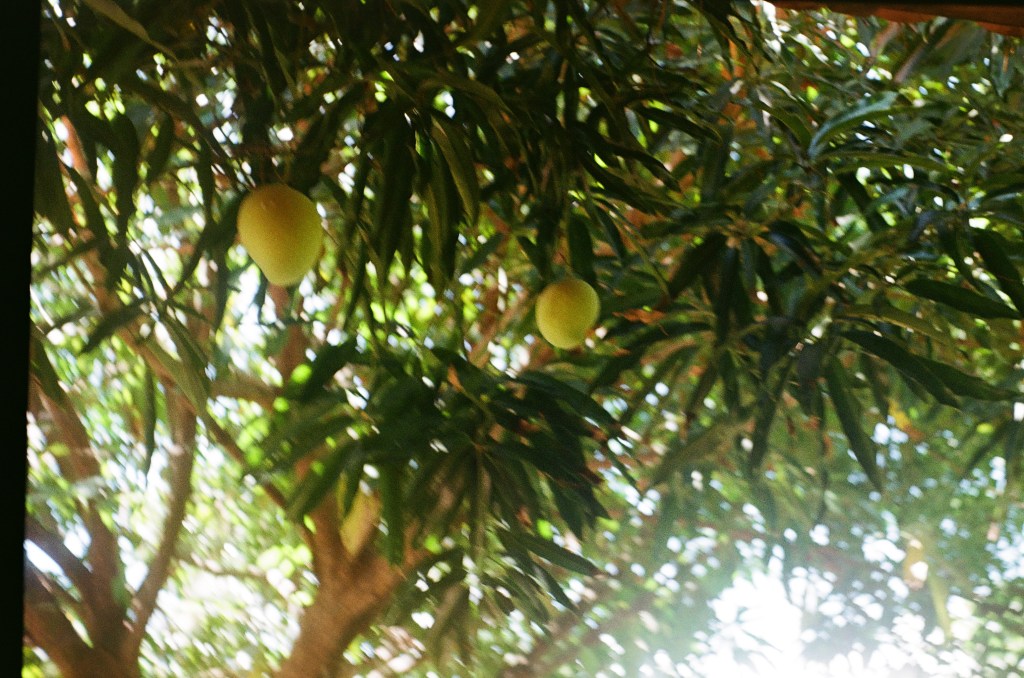
“Mangueira.” A Mango tree. Captured on a Praktica L2 35mm film camera, with Fuji Color ISO 200. Circa December 2024.
Brazilian filmmaker Fernando Meirelles once said: “I understand English, but I don’t feel English. If you say ‘mango tree,’ in English, it is just a tree. In Portuguese, ‘mangueira’ reminds me of my mother… It is different.” People often ask me if I miss home. I say I do. I “miss” home, because I lack the vocabulary to explain how I truly feel. I started learning English at the age of seven or eight. It was around that time that I lost my first baby tooth. Despite my long-lasting domain over the language, sometimes English presents much of a hurdle in describing my feelings. It can only scratch the surface. Some feelings cannot be named, if not in Portuguese.
There are many words in Portuguese that are untranslatable to English, and there is one that pertains to this article: saudade. Saudade is a feeling of longing, of missing something that has long vanished. You feel saudade — of something, of someone, of a place, of a time, of a state-of-being. I feel saudade of my parents, I feel saudade of my childhood dog. I feel saudade of the friends I lost in the way of becoming the person I am. I feel saudade of the cities I lived in before: of my hometown, of Saint John, and of Fredericton. I will certainly feel saudade of Hamilton, when my time here is done.
I feel saudade of home, whatever ‘home’ means — and wherever that is. When I am in Canada, I feel saudade of Brazil. When I am in Brazil, I feel saudade of Canada. So, because I am neither entirely here nor there, home feels like nowhere. It is a pilgrim’s curse: no matter where I am, I will always long for home. And people will remind me of this eternal non-belonging. “When are you going back?” They ask, but I have just arrived. It is awkward, but it is hard to develop a conversation with me that does not involve the word “cold,” or frio. “Is it cold there?” You already know the answer, ask me something else! The hardest thing of living abroad is that you slowly become something of a stranger to most people around you. That is why conversing is so tough; people get used to your absence. The river does not stop running, and life “back home” did not stop when I landed in Montreal in late 2019. I cannot step into the same river twice, no-one can.
So far, I have only rambled. What does Bad Bunny have to do with the existential quarrel that I face?
For the last few weeks, I have been listening to Bad Bunny’s newest album. Benito’s salsa-infused reggaetón and dembow have warmed me through the freezing cold of Hamilton, ON. In many ways, it has been more effective at it than my apartment’s radiator. Talk of an album that instantly lifts my mood, that inspires me to move. Even though I don’t like dancing – my hips do lie – I have endeavored some salsa moves in the kitchen. More than giving me energy, Bad Bunny’s album has made me think of the perennial saudade that exists within me. It made me feel saudade even further, it made me confront – and accept – this feeling.
DtMF is an album about longing for and cherishing the past, no matter how much it hurts. It is about missing one’s family, a past lover, community, and culture. Despite its boisterous, upbeat melodies, some of the lyrics are tremendously bittersweet. Saudade often sets in after moments of extreme happiness. How can you miss something that was not, at least in part, good? For those of us who chose to leave Latin America, who chose to leave our countries in search of an education, for work, or simply a better life, Bad Bunny’s album stings as much as it soothes.
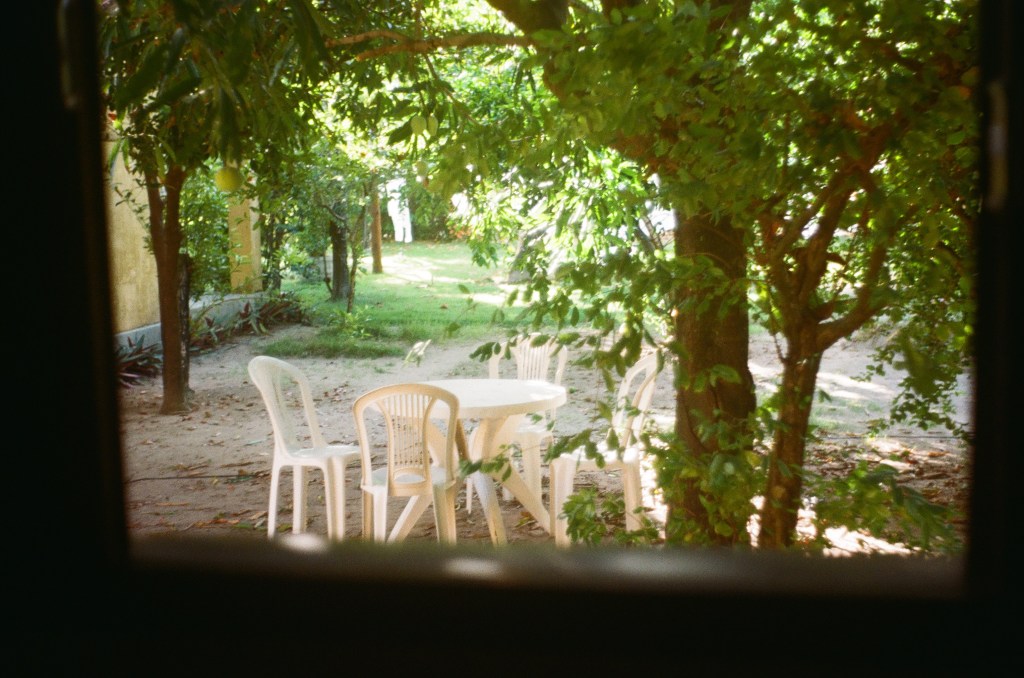
“Empty chairs at empty tables.” Four plastic chairs around a plastic table, under a mango tree. Captured on a Praktica L2 35mm film camera, with Fuji Color ISO 200. Circa January 2025.
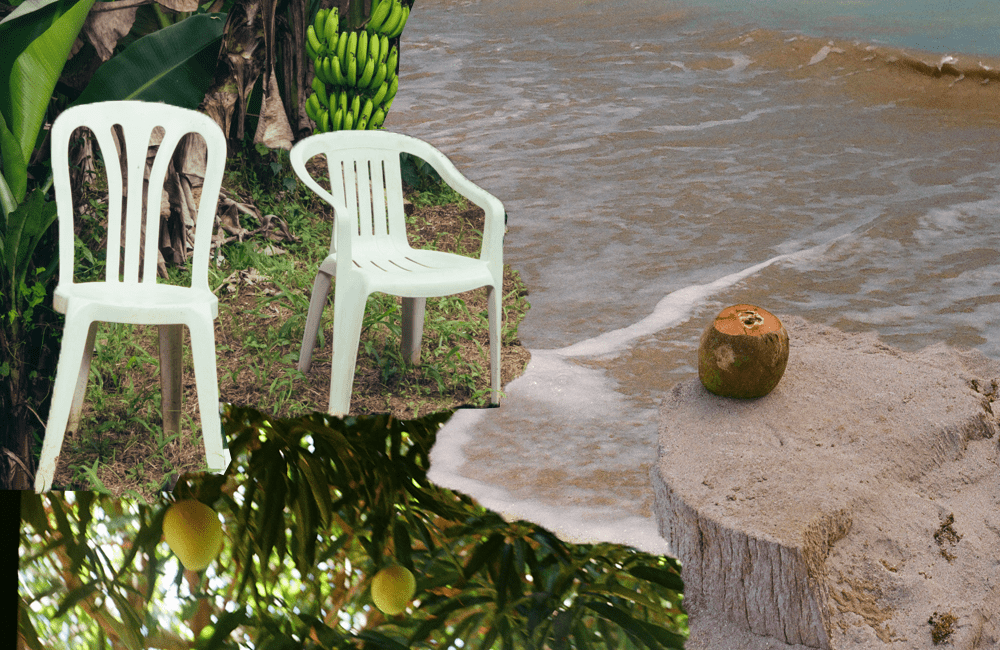
The pair of plastic chairs in the album’s transmit emptiness, as if two people had just been sitting there, chatting; but the photographer was too late to capture them. If you are Latin American, you know what those chairs represent: community. They represent sitting on the garden, or at the beach, or on the sidewalk. They represent chit-chat, laughter, music, and a good beer. You sit on those in parties and in barbeques, because they are so convenient and practical. When the chairs are empty, the party is over. The people are gone, all that is left are memories. All you can think is what you might have done differently. Should you have taken more pictures, or are the memories etched on your brain enough to quench your saudade?
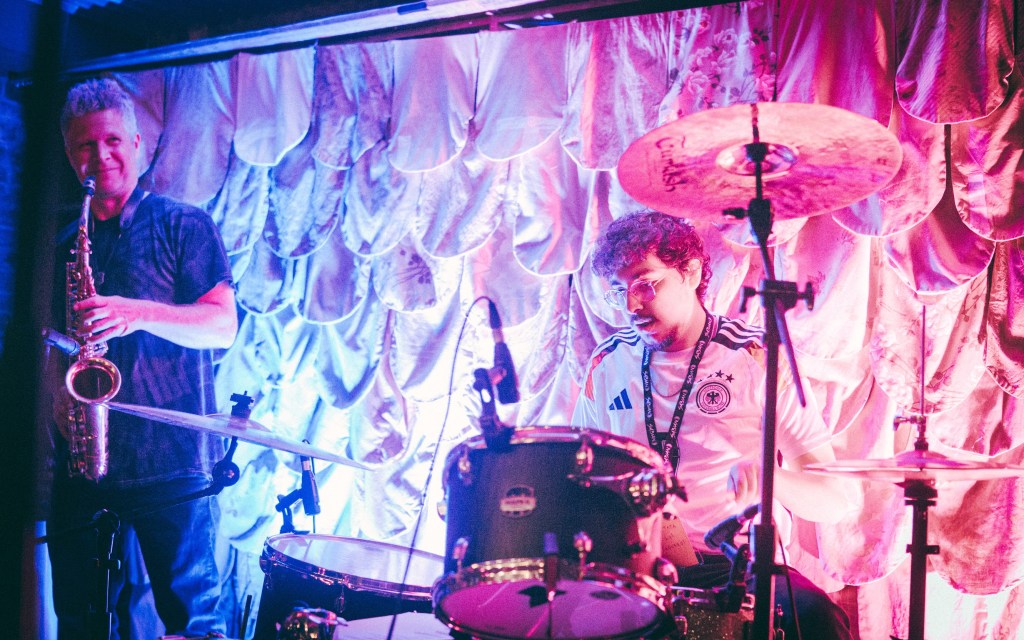
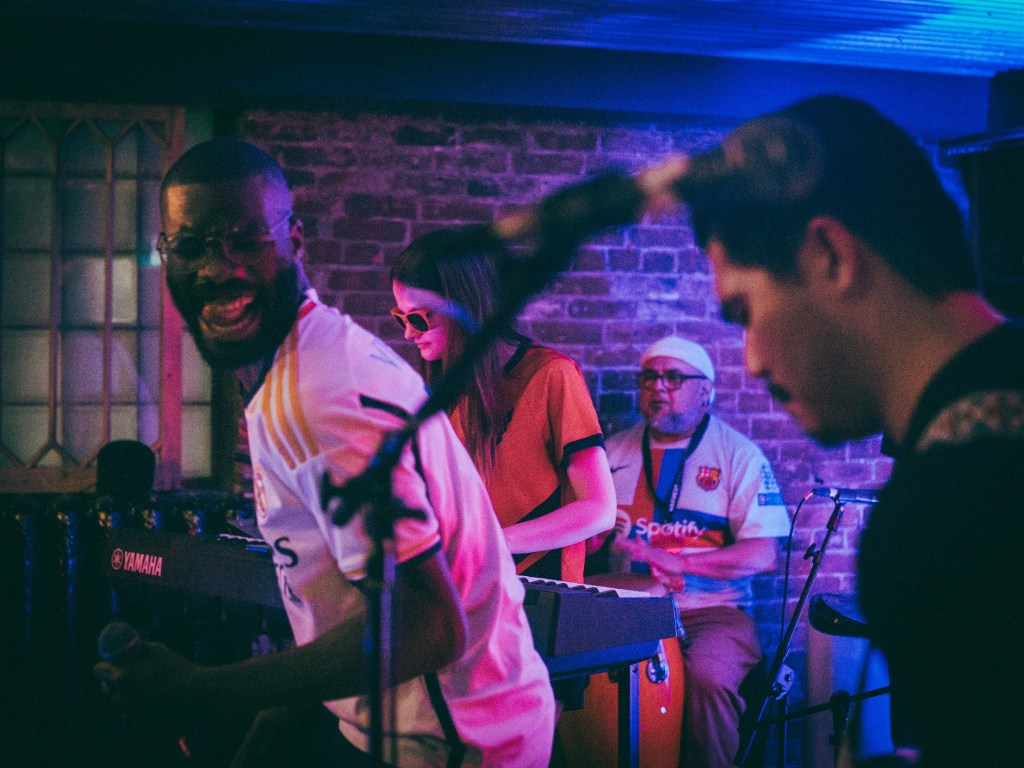
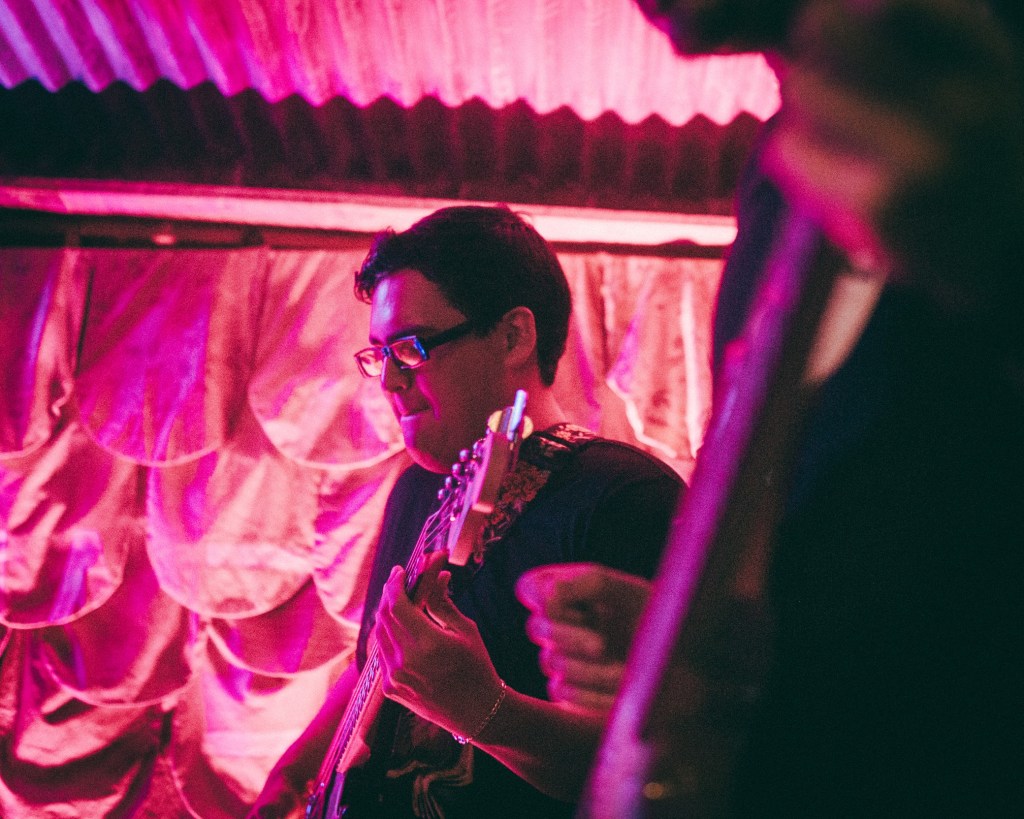
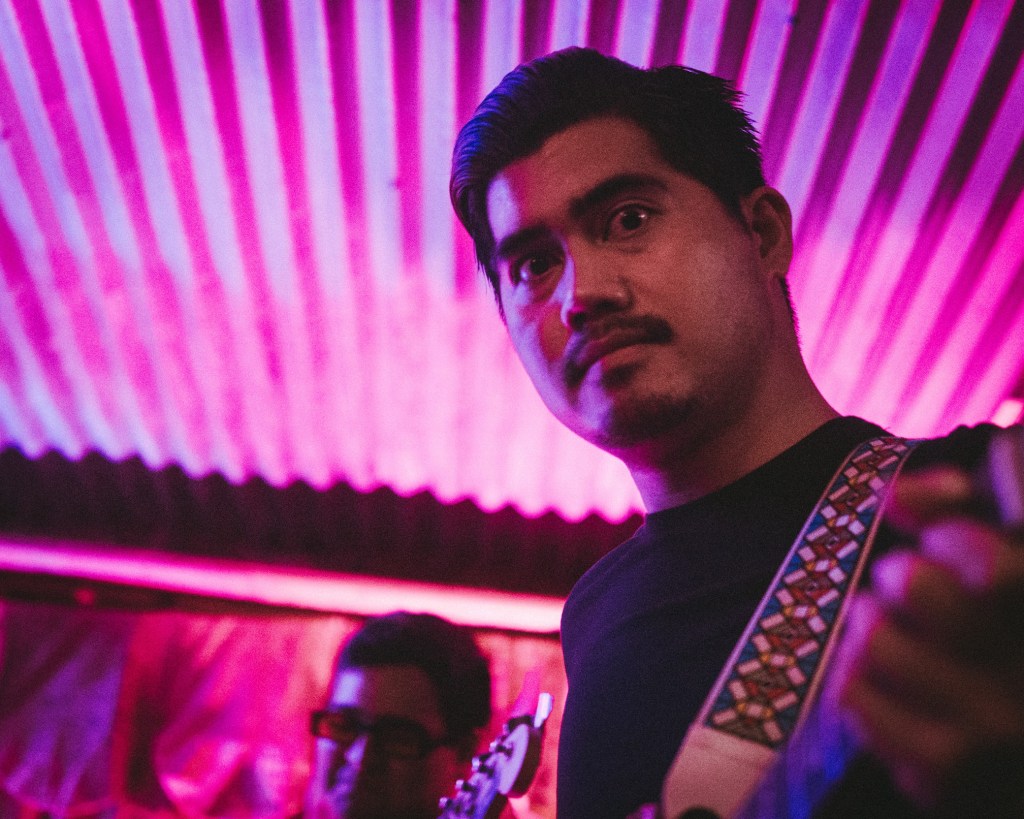
El Tata y Los Taqueros play at The Cap on Flourish Fest 2024 (Photos: McKenzie Power)
It is hard to define El Tata y Los Taqueros. Believe me, I have tried. The Fredericton-based band plays Latin American lo-fi, dabbling in genres such as funk and blues. The band, which is slowly becoming a staple in the Fredericton community, played last weekend at the Flourish Festival.
To celebrate this occasion, I have sat down with El Tata (Gabriel Ibarra) and two of his Taqueros, bassist Daniel Salas and synth player Margaret Andow. Under the scalding sun of the most recent heat wave, we chatted about music, food, immigration, their upcoming EP, and other exciting topics.
In the Beginning, there was El Tata: The Making of Los Taqueros
Gabriel Ibarra, also known as El Tata, is a multi-instrumentalist musician and producer. He is the band leader of El Tata y Los Taqueros. His story begins far away from Canada: in the tropical scenery of Tegucigalpa, capital of Honduras.
As many foreigners who have come to call Canada their home – including moi – Gabriel arrived in the country as an international student. A couple of years ago, he graduated with a degree in Computer Science from the University of New Brunswick. As for what brought him specifically to Fredericton, Ibarra says: “The decision was financially informed.”
“I had applied to other schools: Concordia, York… I was really into Film for some reason, and wanted to study Film in York.”
“But ultimately, my option was the place that I could afford, and I got a pretty decent scholarship here.”
Ibarra was already a musician before he set foot in Canada. Originally a drummer, he had to develop skills in other instruments to continue producing music without a drum set – which he was only able to acquire last year. “In Honduras, I had not really experienced music outside of [drumming], it was always like ‘I’m gonna go play drums for somebody else’ or something like that,” he explains.
“Because I did not have access to drums for so long, I was kind of forced to scratch that itch of music through other means, like guitar, singing, whatever.”
“Once COVID hit, it gave me that awakening,” Ibarra continues, “because I had so much free time and I was like ‘Well, why don’t I just [inaudible], see what happens.’ That was really what influenced me.”
In this struggle, El Tata crossed the bounds of what had been previously possible for him, evolving as a musician. “I don’t think myself in Honduras would have ever done it, because there was no need for it,” he explains. “In a way, I am grateful for that necessity, because it helped me grow as a person and as a musician.”
El Tata y Los Taqueros branched off from Ibarra’s solo project, El Tata. Back in the day, he explains, “none of us were there, except from me.” When the band emerged, it was only meant to support him.
“I used to play with ChillTeens, but I didn’t want to depend on them so much, so I started looking for other musicians.”
“Daniel [Salas] is someone I met a while back, and when we first met him we talked about playing music together. I knew he played bass and I invited him over.”
On a later date, Salas told me about his first meeting with Gabriel Ibarra. “One night drinking outside of The Cap, I saw a guy recording a music video – and I got curious and went straight to him to ask what he was doing,” he said.
Ibarra and Salas have similar trajectories. They both came from Latin America to study in Fredericton – but while Ibarra studied Computer Science at the University of New Brunswick, Salas took History and Journalism a little further up the hill, at St. Thomas University. Aside from his musical endeavors, Salas is a photographer – sharing his breath-taking shots of Fredericton on Instagram.
As Ibarra, Salas was a musician before moving to Fredericton. He recalls playing the bass by himself, in his room, for a few years before joining El Tata. “As soon as I had that experience [playing with a band, for a crowd], it was great,” says Salas, “it [felt] like home.”
“Musically being with him has expanded my horizons from [being a] rough bass player that just liked rock or punk to a multi-genre enjoyer,” Salas told me.
Ibarra talks about the old days: “We played with Oscar [ChillTeens], Dorian, and Dawson [Merci Buckets]. But that was just to play my music.”
That might have been the original line-up, but a lot has changed ever since – band members coming and going, moving to other cities, and being replaced with new musicians. The band’s current line-up is: Gabriel Ibarra (lead and main producer), Charly Benz Trani (guitar), Daniel Salas (bass), Margaret Andow (synth), Joel Miller (current sax player), Teijiri Emore (saxophone), and Cesar Alberto Morales (percussion).
Margaret Andow is the newest addition to the band. For those well-acquainted with the Fredericton music scene, you might know Margaret as the lead of Calibunga – an exciting, youthful pop rock band. According to Margaret herself – quotes from Calibunga’s gig at Flourish – they cover the favorite songs of both dads and of indie boys. I thought it was an apt description.
Ibarra met Margaret at a bus stop. “You were like ‘when is the bus coming?’ And then: ‘Oh, you’re from Calibunga.’ I just played piano at the time. And he was like: ‘You’re gonna play for me,’” she recalls.
“I had known Margaret from Calibunga, and I really loved her energy and wanted to bring her over to the band,” says Ibarra. Margaret played her first gig with Los Taqueros around October, at The Cap. Then, Margaret recalls, they played at Saint John: “It was the first time I traveled for a gig, and I was like ‘this is so fun.’”
Putting Together a Musical Mosaic: Defining and Describing Los Taqueros
Daniel Salas describes El Tata y Los Taqueros as a ‘jam band’: “We don’t have set of things that we play, we extend songs when we are playing, like ‘Oh, one more’ [depending on] how we feel in that moment.”
“We are definitely very Latin American influenced, I would say, but also funk influenced,” says Ibarra. Their sound is in the balance of all these genres and influences, which are remarkably multicultural. Each of the band members bring to the table their own influences: this diversity in taste and culture shapes the sound of Los Taqueros.
“Our guitarist [Charly Benz], he is not here, but he is very blues-inspired, and he really brings that sound over to the band,” continues Ibarra, “whereas I am the drummer and I am very funk-inspired, so that’s my thing. Very fast rhythms and stuff. And Margaret also plays a lot of rock and roll.”
In his solo project, El Tata has put out Spanish-language songs such as Frío and Locos – which are bangers, if I may say. For the band’s upcoming EP – currently in the works – Ibarra says that they may “do anything” in terms of language.
“Benz, who is Filipino, brings a lot of that… And there is a huge Filipino community in Fredericton, so he brings a lot of that sound over and a lot of it is in Tagalog,” he explains, “so I feel like we could release songs in Spanish, and in Tagalog, and English.”
Sounds exciting, especially in a province such as New Brunswick – which has only relatively recently begun to experience cultural and ethnic diversity. “We do feel like we are filling up a niche, because I can’t think of a band that does what we do, and that is not to brag or anything like that,” says Ibarra, “but there is not a lot of diversity here.”
Fredericton has a growing Latin American community. I, myself, have been part of this community for the last three years. And if I had a nickel for each Brazilian, Honduran, Colombian, Argentinian, Bolivian, Mexican or Ecuadorian that I have met… We are everywhere, but the community is remarkably diffuse. Can El Tata y Los Taqueros serve as a catalyst for this energy?
“There is almost a feeling that we don’t really know where to go, we don’t know where to hang out, where is all the stuff that we like, where is all that stuff?” Says Ibarra.
“And that is what we are trying to bring, some sort of sense of community, not only to Latin Americans, but to really anyone that is willing to listen,” he concludes.
Up and Down the Equator: Making it as an Artist Away from Home
Daniel Salas still maintains connections to the music scene in his home country, Ecuador. About his musician friends from back home, Salas says: “I know I am proud of them. I’m like ‘yay, my friends put out an album,’ or ‘yay, they won an award.’”
“I love all my musician friends from Ecuador, and I still share and repost all their content that they share or the music they release, because I know that they would do the same for me,” Salas told me at a later date.
“As an artist making it in Canada, [it] feels like everything is possible if you try a little hard,” he concluded.
Ibarra’s experience is similar to Salas’, but with the addendum of the peculiarity of the Honduran musical scene. “I still maintain as much as I can some sort of connection to the music scene,” he says.
“To be honest, this is a separate topic, but in general Honduras’ [music scene] has always suffered, and it was pretty much non-existent, or very, very small,” Ibarra explains, “until a couple of years ago.” Compared to other countries, such as Brazil or Argentina, Honduras is still incipient in its musical landscape and influence.
“I always wondered why we don’t have any of this, and in the last couple of years it has been changing. So that has helped me to remain hopeful and remain involved.”
“I have friends who have their own band, and they are doing pretty good, and they are my connection to the music scene,” he continues.
“And hopefully one day I can go there and play, and feel like I am playing at home,” Ibarra concludes.
On Taquería El Tata: Food, Music, and Everything in Between
Even if you do not attend El Tata y Los Taqueros’ concerts, you might know El Tata from his other venture: Taquería El Tata, which provides authentic Mexican-Honduran fusion cuisine to the Fredericton community through sporadic pop-ups. This Spring, the Taquería has already had two pop-ups at The Cap – and last year it was present at the Garrison Night Market.
If El Tata is already a brand, it is one that merges music and food. So much so that, for Flourish’s zine, the band submitted a recipe of Pork Carnitas!
El Tata y Los Taqueros‘ submission for Flourish Fest’s 2024 zine
When asked about it, Ibarra said that music and food are “100%” connected: “What I like is the humanity of it, the expressions that come through music, the same sort of stuff comes through food.”
“Food carries a significant cultural history, I suppose,” he explains, “a history of struggle is represented through food, which is why, for example, tamales from back home were the sort of food that Native Americans would just grab whatever they could from the Spanish.” These ingredients would become part of their cuisine.
“That sort of information, that sort of significance, [also] comes with music,” he says.
“I want to show people certain things, for example, how much Honduran food can be good,” he continues.
“Certain decisions that I made, certain ingredients that we use, are explicitly Honduran,” states Ibarra, “people don’t really think about that, it is sort of unconscious.”
To Conclude…
El Tata y Los Taqueros is one of Fredericton’s most exciting bands. Slowly becoming a cornerstone of Fredericton, the band’s sound is the result of its members’ diverse backgrounds, influences, and life trajectories. Even though their music is not available on Spotify, I have been told that their first EP is currently in the works – so stay on the lookout for that. In the meantime, you can check out El Tata’s solo music and follow him on Instagram.

 The Apologist